Destination Guide
9 min read
A Guide to Historic Downtown Fernandina Beach
More than fifty blocks on the National Register, Florida's oldest bar, and a museum in the old county jail. What to see in downtown Fernandina Beach, how the parking actually works, and when to go, from twenty-five minutes up the road in Yulee.
Edited by First Coast Inn Editorial Team
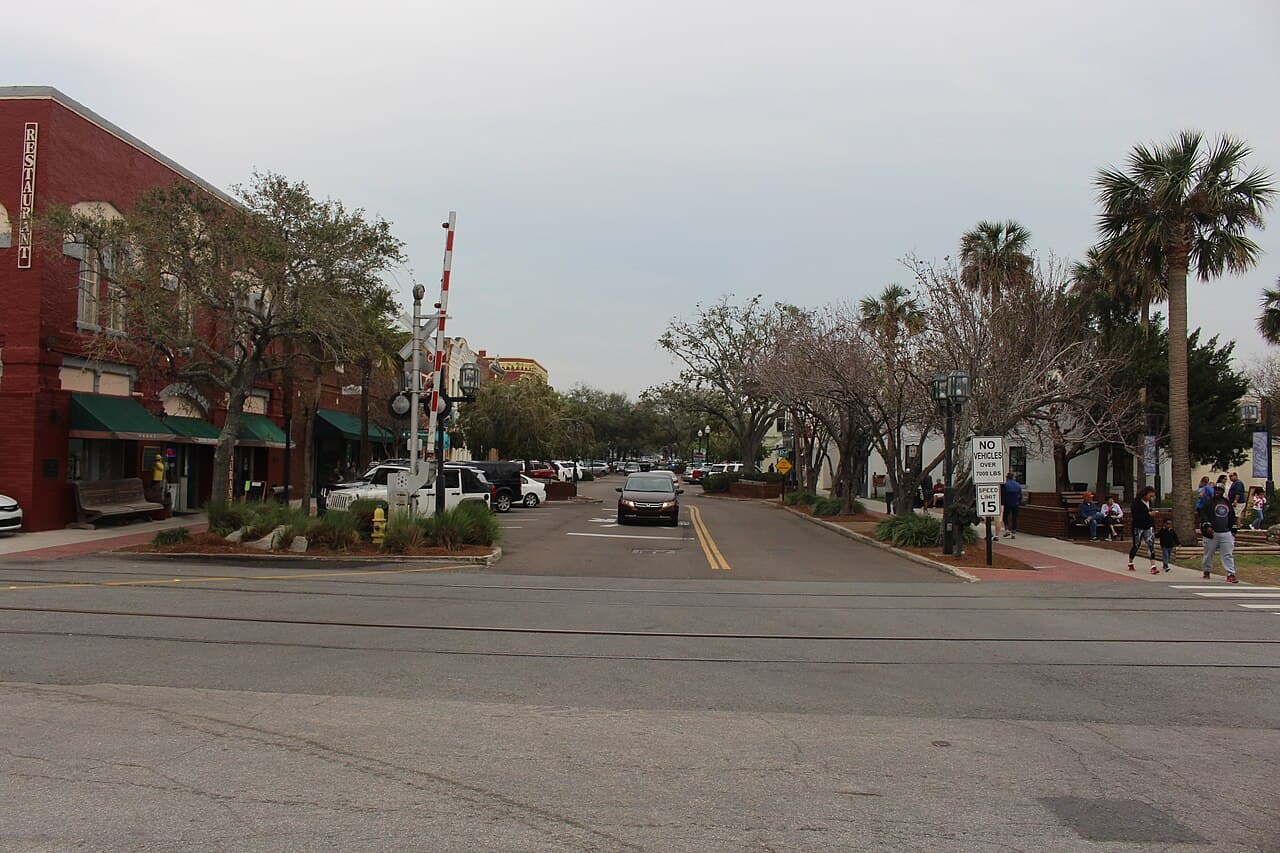
Photo by Michael Rivera on Wikimedia Commons · CC BY-SA 4.0
Downtown Fernandina Beach is a long argument for leaving things alone. The building stock is largely late-1800s, the street grid still runs west to a working river, and railroad tracks cross Centre Street down near the water. The National Register listed the district in 1973 and expanded it in 1987. More than fifty blocks of it are protected. Nothing here has been rebuilt to look old, which is the highest compliment you can pay a historic downtown.
We're not in it. We're in Yulee, on the mainland, about twenty-five minutes west across the marsh, and downtown is a place we drive to like everyone else. That matters for exactly one reason, and it isn't distance. It's parking, which is where first-time visitors lose their first hour. More on that below, because the rules changed recently and are about to change again.
Why this particular downtown looks like this
Eight flags have flown over Amelia Island: French, Spanish, British, Patriot, Green Cross, Mexican, Confederate, and American. That's the fact everyone leads with, and it sounds like trivia until you understand what it did to the town. A place that changes hands that many times gets rebuilt by each new set of owners, and the version that survived into the twentieth century is the Victorian one.
The other engine was shrimp. Fernandina is the birthplace of the modern shrimping industry, and boats still work out of the harbor at the foot of downtown. The money from that era built the storefronts you're walking past, and the industry never fully left, which is a large part of why the waterfront still smells like a working port instead of a marina development.
What you get, walking around, is a downtown that reads as continuous rather than curated. The commercial core is brick. A block or two off it, the Victorian houses are houses, with cars in the drive and mail in the box. There are gaps and infill and a few buildings that need paint. That's what a real historic district looks like when nobody has turned it into a set.
Centre Street
Start at the river end and walk east, which is the direction the hero photo above is looking. You'll cross the tracks, pass the storefronts, and hit the shade trees. It's flat, the sidewalks are wide, and you can cover the commercial stretch and back in well under an hour if you don't stop. You will stop.
We're not going to hand you a list of shops. Retail on any historic main street turns over, and sending you looking for a boutique that closed last spring helps nobody. Treat the street itself as the attraction: go into whatever has an open door, and expect a mix of galleries, gift shops, clothing, and places selling things made within a hundred miles of the counter. The side streets are worth the detour. Some of the best of it isn't on Centre.
The Palace Saloon
117 Centre Street, and worth the stop even if you don't drink.
The building went up in 1878 as a shoe store, commissioned by Josiah Prescott. In 1903 a German immigrant named Louis G. Hirth turned it into an upscale bar aimed squarely at the ship captains and wealthy visitors coming through the port, which earned it the nickname it still carries: the Ship Captain's Bar. It has been pouring ever since, and that unbroken run is what makes it Florida's oldest continuously operating bar rather than just Florida's oldest bar building.
One honest caveat. Its hours move around and we couldn't confirm current ones, so if the Palace is the reason you're making the drive, call before you go. Same for any age policy, which we can't confirm either. If you're bringing kids, ask first rather than finding out at the door.
The Amelia Island Museum of History
233 S. 3rd Street, a short walk off Centre, in the former Nassau County Jail. The building is part of the pitch. So is the museum's own claim: it is the first spoken history museum in the state of Florida, which in practice means the storytelling is the exhibit and a docent is the delivery mechanism.
Which is why the timing advice here is specific. Docent-led tours run Monday through Saturday at 11 a.m. and 2 p.m., and Sunday at 2 p.m., and they're included with a ticket. Show up at 12:30 and you'll see the rooms without the thing that makes the place work. Aim for a tour slot.
Regular hours are Monday through Saturday, 10 a.m.–4 p.m., and Sunday 1–4 p.m., open year-round. There are also free Friday hours from 4 to 6 p.m., which is a genuinely good deal and the single best argument for making Friday afternoon your downtown afternoon. Admission prices aren't listed on the museum pages we could read, so don't take our word for a number we don't have: buy at ameliamuseum.org or call 904.261.7378.
Parking, honestly
Here's the part that trips people up, and it's changing, so read the dates carefully.
As of publication, downtown Fernandina Beach parking is paid. The first 20 minutes are free, then it's $2 per hour, with enforcement Monday through Saturday from 10 a.m. to 8 p.m. and Sunday from 1 to 6 p.m. The city's public lots downtown sit inside that zone, so the old advice about pulling into a free lot off Centre is out of date.
The program is on its way out. Voters ended it in August 2026, and the city is running out a vendor notice period, with its own parking page stating that November 18, 2026 will be the final day. If you're reading this after that date, the meters should be gone, but confirm rather than assume: the city's parking page is the authority and takes ten seconds to check.
Two practical notes either way. Beach parking on the ocean side of the island is a separate matter and isn't part of the downtown paid zone. And whatever the rules are on the day you go, park once. The district is flat and compact, and moving the car between Centre Street and the museum costs more time than walking it.
When to go
Seasonally, downtown is the most weather-proof thing on the island. Rain that ruins a beach day barely dents an afternoon of shops, a museum, and a long lunch, which makes the historic district the correct rainy-day fallback rather than a consolation prize.
Spring is the prettiest, with azaleas out and temperatures in the seventies and low eighties. It's also when the Isle of Eight Flags Shrimp Festival lands, in early May, and that weekend the festival takes over downtown completely. It's a great festival. It is not the weekend to browse.
Summer brings heat, humidity, and afternoon storms that pass through and clear out, and the shaded blocks handle it better than the beach does at two in the afternoon. Fall is our pick: the crowds thin after Labor Day, the light gets good, and evening on Centre Street is comfortable again. September carries hurricane-season risk worth watching, but it also delivers the quietest good weather of the year. Winter is mild, in the sixties by day, cheap, and close to empty. If you want the district to yourself, come in January.
By day and hour: weekday mornings are the quietest, Friday late afternoon gets you the museum's free window, and weekend evenings are when the restaurants fill and the street feels most alive. Pick according to what you're there for.
Where to stay
The honest version. Staying downtown is genuinely lovely and genuinely expensive. There are bed-and-breakfasts in Victorian houses inside the district where you park once for the whole trip and walk to dinner, and if that's the trip you want, book one. Down the island there are resort-scale properties with beach access and prices to match.
We're the other option. The Best Western Plus First Coast Inn & Suites is on State Road 200 in Yulee, about twenty-five minutes from Centre Street, thirteen miles from Jacksonville International Airport, and right where A1A meets the I-95 corridor. You trade the walk-to-dinner convenience for a lower rate, free parking that fits a boat trailer, free hot breakfast, and a pool for when you get back. For a trip that mixes downtown with the beach, the fort, and a run south to the Talbot Islands, you're driving anyway. Current rates and packages are on our special offers page.
What we won't do is pretend the bridge isn't there. If your plan is three nights of walking out your door into the historic district, we're the wrong hotel, and we'd rather tell you that now.
Where to eat
Downtown carries the island's dining, and the short version is that the restaurants buying local shrimp are noticeably better than the ones that aren't. You'll find riverfront tables near the marina, tapas and white-tablecloth places on and around Centre, and casual seafood in the blocks between. We keep our honest notes, with distances from the hotel, on our dining page rather than in a guide that would go stale.
On our side of the bridge, Bob's Famous BBQ is a family-run smokehouse stand directly across State Road 200 from the lobby, which is the correct answer when you get back from downtown too late and too full of ambition to drive anywhere else. Our guide to eating near Yulee covers the rest of the mainland options.
First-timer mistakes
Treating downtown as a stopover is the big one. Forty minutes between the beach and dinner gets you a walk down one side of Centre Street and nothing else. Give it a half day.
Showing up Sunday morning for the museum is the second. It doesn't open until 1 p.m. on Sundays, and the only Sunday docent tour is at 2 p.m.
Assuming you can walk from your hotel is the third, and it applies to us specifically. Downtown is a drive from Yulee, roughly twenty-five minutes each way, so if the evening involves drinks, sort out who's driving before you leave.
And don't try to see the whole district. More than fifty blocks is more than an afternoon. Do Centre Street, one museum, the waterfront, and two or three residential side streets, then come back another day. For the wider island, our first-timer's guide to Amelia Island and our things to do page cover the fort, the beaches, and the water.
The short version
Park once, ideally on a Friday afternoon. Walk Centre Street from the river end. Take the 2 p.m. tour at the old jail, or come back at 4 for the free hours. Have a drink where the ship captains did. Then eat something that was in the ocean that morning.
Planning the trip from the mainland side? Check availability or call the front desk at (904) 225-0182, and ask us about the parking situation before you drive over. We'll know what it's doing that week.
FAQ
Common questions.
What is there to do in downtown Fernandina Beach?
Walk it first. The historic district covers more than 50 blocks on the National Register, and Centre Street is its spine, running from the Amelia River waterfront east through blocks of late-1800s brick storefronts. The two anchors are the Palace Saloon at 117 Centre Street, Florida's oldest continuously operating bar, open since 1903, and the Amelia Island Museum of History at 233 S. 3rd Street, housed in the former Nassau County Jail. Shops, galleries and restaurants fill the rest, and the marina and waterfront sit at the west end.
Is parking free in downtown Fernandina Beach?
Not as of publication. Downtown parking is paid: the first 20 minutes are free, then it's $2 per hour, enforced Monday through Saturday 10 a.m.–8 p.m. and Sunday 1–6 p.m. The city's public lots downtown are inside that zone. Voters ended the program and the City of Fernandina Beach says November 18, 2026 will be the final day, so check fbfl.us/873/Parking for the current rules before you drive over. Beach parking on the ocean side of the island is a separate matter and is not part of the downtown paid zone.
What are the hours at the Amelia Island Museum of History?
Monday through Saturday, 10 a.m.–4 p.m., and Sunday 1–4 p.m., year-round. Docent-led tours run Monday through Saturday at 11 a.m. and 2 p.m. and Sunday at 2 p.m., included with a ticket. There are also free Friday hours from 4 to 6 p.m. Admission prices aren't published on the pages we could read, so buy through ameliamuseum.org or call 904.261.7378.
How old is the Palace Saloon in Fernandina Beach?
The bar opened in 1903, which makes it Florida's oldest continuously operating bar. The building itself is older, dating to 1878, when it was built as a shoe store. German immigrant Louis G. Hirth converted it into an upscale bar for ship captains and wealthy visitors, which is where the 'Ship Captain's Bar' nickname comes from. We don't publish its hours because they change. Call ahead if it's the reason you're driving over.
How far is downtown Fernandina Beach from Yulee?
About a 25-minute drive east on State Road 200/A1A, across the Thomas Shave Bridge onto Amelia Island. Our hotel sits directly on that road in Yulee, which is why a lot of our guests do downtown as an afternoon and evening rather than a full day.
Planning a trip to the First Coast?
We’re about twenty-five minutes from Amelia Island’s beaches and thirteen miles from the Jacksonville airport.
Check Availability