Listicle
10 min read
6 Best Beaches Near Yulee and Amelia Island
Six stretches of Atlantic sand within driving range of Yulee, ordered by what each one actually gives you: facilities, history, shade, or almost nothing at all. Plus the county rules on dogs, lifeguards, fires and driving on the sand.
Edited by First Coast Inn Editorial Team
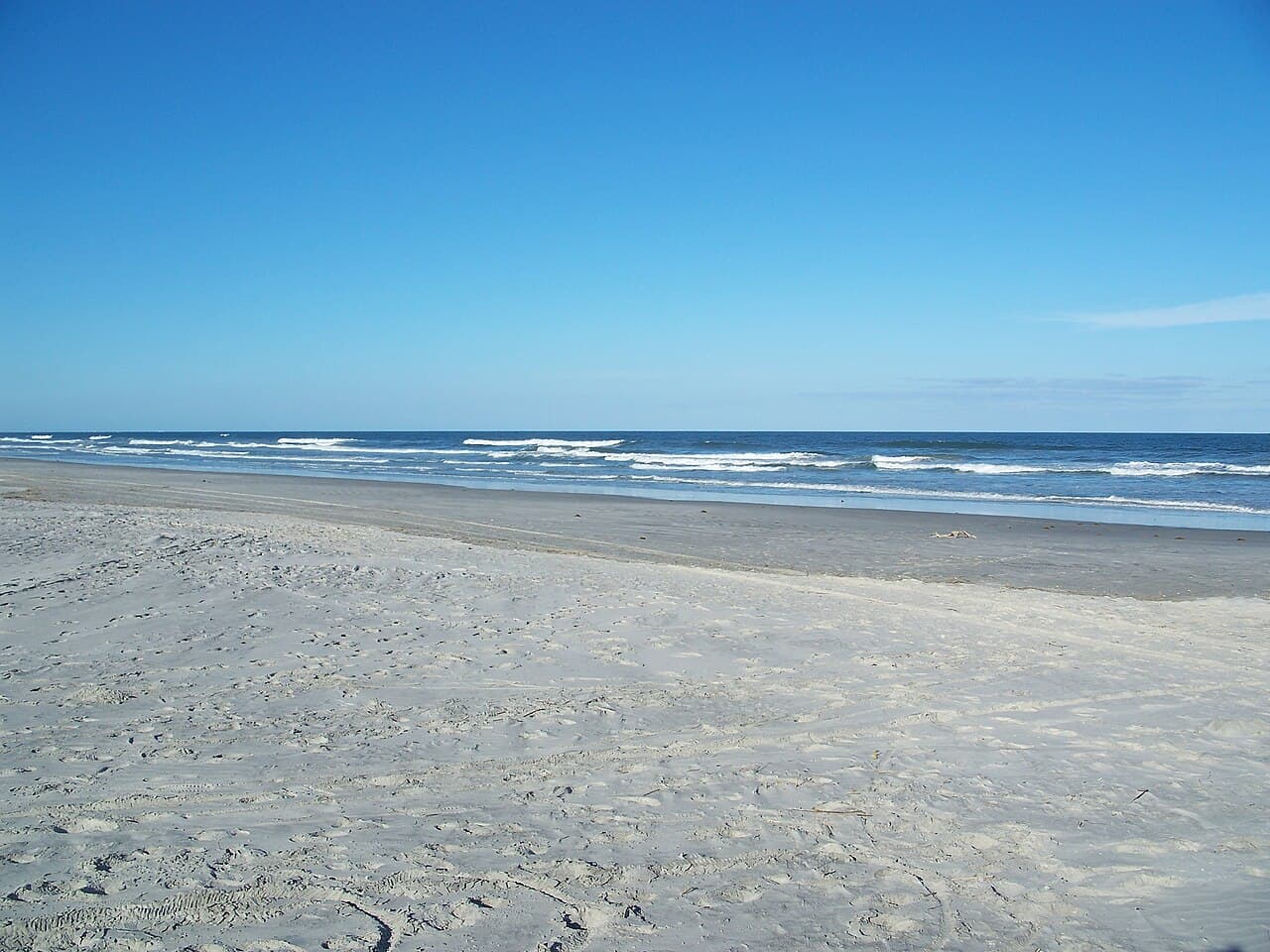
Photo by Ebyabe on Wikimedia Commons · CC BY-SA 3.0
Our front door opens onto State Road 200, not the Atlantic. The nearest sand is about 15 miles east, roughly 25 minutes across the Shave Bridge, and there is no version of this post where we pretend otherwise.
What you get for that drive is a choice. When the beach is a destination rather than a doorstep, you stop defaulting to whichever stretch is closest and start picking the one that suits the day. The one with volleyball nets and a bathhouse. The one with showers and shore fishing and a century of history behind it. The one where you might see four other people.
You can also bring the dog, which is not true everywhere on the Southeast coast. Nassau County permits dogs on its beaches on a leash, and we take dogs too.
Here are the six we actually send guests to, ordered roughly by how often we send them.
First, the rules that apply everywhere here
These come from Nassau County, and they hold no matter which access you use.
- Dogs are allowed, leashed, always. The county's language is specific: dogs "must be under a leash at all times," owners may not let them run at large, and owners "shall remove and dispose of dog's litter from beach." A violation can draw a $100 civil citation. Full text on the county's beachfront parks page.
- Lifeguards are seasonal. Nassau County staffs stands at North End Park, Main Beach, Seaside Park, Peter's Point, Scott Road and Burney Park from May through Labor Day. Every other week of the year the beaches are open and unguarded. Before you swim, check the surf and rip current forecast at weather.gov/jax, and read the county's beach safety page.
- No beach fires from May 1 through October 31. That is sea turtle nesting season. Outside that window, fires have to stay clear of the dunes and the vehicle areas, and treated wood is not allowed.
- Beach parking is not the downtown paid-parking zone. The city's paid zone covers downtown only, Ash to Alachua and Front to 8th. Beach access lots sit outside it and post their own hours. Neither the city nor the county publishes a beach parking fee, so trust the sign at the lot rather than any blog, this one included.
- Driving on the sand is permit-based and built for residents. Peters Point, Burney Park and Scott Road have vehicle access, but proof of residency or property ownership is part of the county's requirement, with separate provisions for active-duty military and disabled visitors. Vehicles must be four-wheel drive, all-wheel drive or meet the beach buggy definition. ATVs, motorcycles and dirt bikes are out. Vehicles are off the sand from 7:30 p.m. to 7:30 a.m. between May 1 and October 31, and from 9 p.m. to 7 a.m. between November 1 and April 30. If driving the beach is the whole point of your trip, read the county's rules first.
1. Main Beach Park, Fernandina Beach
The default answer, and there is no shame in it. The island's tourism office calls Main Beach "Amelia Island's most visited beachfront park," and it earns that with volleyball courts, picnic areas and the shortest walk from car to water of anything on this list. A lifeguard stand works it in season.
It is also the closest to us: 15 miles, about 25 minutes east on A1A.
If it is your first trip, start here. If it is your fifth, you already know the trade. Most visited means most visited, and in high summer the lot fills long before lunch. The move is to go early, or to go at all on a weekday, or to pick something further down this list.
Best for: a first beach day, families who want facilities within sight of the towel.
2. Peters Point Beachfront Park
Peters Point is where we send people who do not want a parking fight. The tourism office describes it as centrally located, easily accessible, and with plenty of parking, and in practice that holds up on days when Main Beach has cars circling. It carries a lifeguard in season.
Two details set it apart. It is one of the county's designated vehicle access points, with the permit and residency rules above. And it has horse-trailer parking, which tells you what kind of beach it is: wide enough and quiet enough that people ride here.
Best for: a Saturday when you left later than you meant to.
3. Burney Park at American Beach
This is the most historically significant stretch of sand on the island, and it is worth knowing why before you spread a towel on it.
American Beach was founded in 1935 by Abraham Lincoln Lewis, Florida's first Black millionaire and a co-founder of the Afro-American Life Insurance Company. The company developed the beach as a place where Black Floridians could enjoy the Atlantic shore during segregation, when almost none of this coast was open to them. It went on the National Register of Historic Places on January 28, 2002, and the American Beach Museum opened in 2014 to tell the fuller version of the story. Go with that context in mind. It changes the afternoon.
Burney Park itself is one of the best-equipped accesses on the island: plenty of parking, shore fishing, indoor and outdoor showers, picnic areas, and a lifeguard in season. Group camping is permitted here, which no other county beachfront park on this list offers.
Best for: a beach day with something to think about, and the best showers of the group.
4. Fort Clinch State Park
Two beaches for one entry fee, at the northern tip of the island. The Atlantic side runs broad and is rarely crowded. The sound side, below the fishing pier, is calmer water and the island's most reliable shark-tooth hunting, because the shipping channel dredge keeps replenishing it with fossil-bearing sand.
Entry is $6 per vehicle. The fort's own $2.50 per person admission is separate and you do not need it to reach the beach, though if you have driven the three miles of live-oak canopy to get in there, you may as well see the fort. Our full Fort Clinch guide covers that side of the day, including the first-weekend reenactments.
Two caveats. Fort Clinch is not on the county's lifeguard roster, because it is a state park rather than a county beach, so plan on swimming unguarded whatever the season. And state parks set their own pet rules, so if the dog is coming, confirm on the park's page before you pay at the gate.
The park entrance is about half an hour from our lobby.
Best for: a half day that is only partly about the beach.
5. North Beach Park
The shade beach. North Beach Park has covered pavilions, picnic tables and boardwalks out to the sand, which makes it the one to pick when the forecast says 92 and somebody in the group is not going to last four hours in direct sun. A pavilion changes the arithmetic of a long beach day with small kids more than any other single feature.
One naming note worth checking before you rely on it: the county's lifeguard roster lists a North End Park among its guarded beaches at that end of the island. Whether that is the same access under a different name is not something we can confirm from the published pages, so if a lifeguard stand is the deciding factor for your group, call it up on the county's beach safety page rather than assuming.
Best for: shade, picnic tables, and a slower end of the island.
6. Little Talbot Island State Park
The farthest of the six from Yulee, south down A1A past Big Talbot, and the one that looks least like a beach park. Little Talbot is an undeveloped barrier island, dune and Atlantic shoreline with a state park's restraint applied to all of it. This is the wide, empty, nobody-for-a-quarter-mile beach that people picture when they picture Florida before the condos.
Entry is $5 per vehicle, and the park runs 8 a.m. to sunset. Bring what you need. It pairs naturally with Big Talbot Island just north, where the Boneyard Beach driftwood is, and the two together make a full day rather than an afternoon, which is the honest way to plan it. Our things to do page has the wider south-of-the-island picture.
As with Fort Clinch, this is a state park, so check its own pet and vehicle rules rather than applying the county's.
Best for: the day you want the beach mostly to yourself and do not mind driving for it.
Honorable mentions
The island has, per its tourism office, more than 40 public beach access points, and the six above are nowhere near all of them. Worth knowing:
- Seaside Park and Scott Road both carry lifeguards in season, and Scott Road is a vehicle access point.
- Southend Walkover and Summer Beach Walkover are two more county beachfront accesses, both walkovers rather than full parks, and neither appears on the county's guarded list.
If a lot looks full, drive two minutes and try the next walkover. That is the actual local move, and it works far more often than circling.
How we picked these six
Four things, in this order.
Drive time from Yulee came first, because that is the real constraint on anyone staying with us. Everything here is inside a comfortable one-way drive, and we have been straight about which end of that range each beach sits at.
Then facilities, meaning the unglamorous ones. Parking that exists on a July Saturday. A shower that rinses the sand off before it gets in the car. A shaded table. These decide whether a beach day is pleasant or a chore, and they vary a lot between accesses that look identical on a map.
Then whether each beach gives you something the previous one does not. A list of six near-identical stretches of sand would be useless. Facilities, history, shade, quiet, and a fort are five genuinely different reasons to drive somewhere.
And dogs, because the county allows them leashed and a lot of our guests travel with one.
Things we deliberately did not rank on: surf quality and rip current risk, which change daily and belong to NWS Jacksonville rather than to us, and per-beach lifeguard stand counts, which are not published in a form we would stake a recommendation on.
Where this leaves you, and us
Being on the mainland side of the bridge is the whole proposition here. We are about 25 minutes from Main Beach and half an hour from Fort Clinch, with free parking, a hot breakfast, and an outdoor pool for the hour between the beach and dinner. Dogs are welcome, up to two per room with an 80-pound limit, at $25 per day capped at $150 per week, subject to a pet-friendly room being available. Beach chair rentals are on the amenities list too, so you can grab one on the way out.
If this is your first trip to the island and you want the wider picture before you start picking beaches, our first-timer's guide to Amelia Island covers when to come and what to skip.
Planning a stay? Have a look at the current offers, or call the front desk at (904) 225-0182 and ask us which beach fits your week. Somebody will pick up.
FAQ
Common questions.
Are dogs allowed on Amelia Island beaches?
Yes, on Nassau County beaches. The county's rule is that dogs must be leashed at all times, may not be at large, and that owners have to remove and dispose of their dog's litter. Violations can draw a $100 civil citation. State park beaches like Fort Clinch and Little Talbot Island set their own pet rules, so check the individual park page before you bring the dog through the gate.
Do you have to pay for parking at the beach in Fernandina Beach?
Beach access lots sit outside the city's downtown paid-parking zone, which runs Ash to Alachua and Front to 8th. Neither the city nor the county publishes a fee for beach parking, and the beach lots post their own hours, so read the signs at the lot you pull into. State parks are different: Fort Clinch charges $6 per vehicle and Little Talbot Island $5 per vehicle.
Are there lifeguards on Nassau County beaches?
Seasonally. The county staffs lifeguards at North End Park, Main Beach, Seaside Park, Peter's Point, Scott Road and Burney Park from May through Labor Day. After Labor Day the beaches stay open but go unguarded until the following season. Check the rip current forecast from NWS Jacksonville at weather.gov/jax before you swim.
What is the closest beach to Yulee, Florida?
Main Beach Park in Fernandina Beach, about 15 miles east on A1A, roughly a 25-minute drive across the Shave Bridge. Yulee is on the mainland, so every beach on this list is a drive. Fort Clinch State Park's beaches are a similar half hour by way of Atlantic Avenue.
Can you drive on the beach on Amelia Island?
There is vehicle beach access at Peters Point, Burney Park and Scott Road, but it is permit-based and geared toward county residents and property owners, who must show proof of residency or property ownership. Vehicles have to be four-wheel drive, all-wheel drive or meet the county's beach buggy definition, and ATVs, motorcycles and dirt bikes are prohibited. Overnight hours are closed to vehicles year-round. Read the county's beachfront parks page before you plan on driving the sand.
Planning a trip to the First Coast?
We’re about twenty-five minutes from Amelia Island’s beaches and thirteen miles from the Jacksonville airport.
Check Availability